Quick answer: Knot magic is the folk practice of tying an intention into cord, thread or ribbon, one knot at a time, so the knots hold it until you keep, untie or release them. In love work it shows up as handfasting cords, lover’s knots and the witch’s ladder. A knot spell is safest and kindest when it is self-focused or tied together with a willing partner.
On this page
Related guidance: Before you tie anything, read how to approach a love binding spell responsibly, see our commitment spell guide for couples, and learn how a cord cutting spell ends a bond when a knot needs to be undone for good.
Knot magic choices: cord colors, knot numbers and their traditional meanings| Choice | Traditional meaning | Best use in a love knot spell |
|---|
| Red cord | Passion, devotion, vitality | A couple’s commitment cord or anniversary renewal |
| Pink cord | Tenderness, affection, self-love | Self-focused knots for opening to gentle love |
| White cord | Clarity, peace, new beginnings | A fresh start after a breakup, or any intention |
| Green cord | Growth, steadiness, the heart | Patience and healthy growth in a relationship |
| Three knots | Past, present and future; a common folk number | Short, focused workings |
| Seven knots | Completion, the days of the week | Naming seven qualities you want to bring or receive |
| Nine knots | Three times three; a traditional charm number | Longer rituals and couples’ promises |
Key Takeaways
- Knot magic ties an intention into cord, and untying is traditionally how that intention is released.
- Historical examples include sailors’ wind knots, the witch’s ladder found in Somerset and wedding customs built around cords and knots.
- A knot tied around someone’s name or belongings without their consent is a binding; tie for yourself or with a willing partner.
- Use natural-fiber cord, a color that fits your intention and a meaningful number of knots, often three, seven or nine.
- Decide at the start how the working ends: keep it, untie it, cut it or burn natural fibers safely.
What Is Knot Magic?
Knot magic is one of the simplest and oldest forms of folk magic. You hold an intention in mind, tie a knot, and treat the knot as the place where that intention is held. Undo the knot, and the intention is released. A knot spell can use any cord, string, thread, ribbon or even a strand of yarn.
The logic is easy to feel in your hands. Tying is binding, holding and committing; untying is letting go. That makes knot magic a natural fit for love, where so much is about joining, staying and, sometimes, parting well.
Because the knot does the holding, the practice asks you to be honest about what you are holding and for whom. That question shapes everything below.
A Short History of Knot Magic in Love and Folklore
Knots appear in magic across many cultures and centuries, both for good and for harm. The Quran’s chapter Al-Falaq, for example, asks for protection from those who blow on knots, a reference to knot sorcery. A few traditions shape modern love knot work most directly.
Sailors’ wind knots. Folklore from Scotland’s northern isles, Scandinavia and elsewhere tells of sailors buying wind tied into a cord with three knots. Untying the first knot was said to bring a gentle breeze, the second a strong wind and the third a gale. The image of power stored in a knot and released by untying it runs through knot magic to this day.
The witch’s ladder. In the late 1800s, a length of cord with feathers knotted into it was found in the attic of an old house in Wellington, Somerset, England. It became known as a witch’s ladder and is now held at the Pitt Rivers Museum in Oxford. Its original purpose is uncertain, but modern witches adopted the name for a knotted cord that holds a series of intentions, often with feathers, beads or herbs tied in.
Handfasting and “tying the knot.” In ancient Rome, a bride’s belt was tied with a Hercules knot that her husband untied. In Scotland and elsewhere, handfasting once meant a betrothal or marriage agreement sealed by joining hands, and modern Pagan handfasting ceremonies wrap the couple’s hands with cords or ribbons. The phrase “tying the knot” has several proposed origins, and these customs are among them. Decorative love knots and betrothal knots, such as the true lover’s knot, have long appeared in jewelry and embroidery as symbols of a promise.
Knot Magic and Binding: Where the Line Is
Every knot is a small binding, which is why knot magic and binding spells are so closely linked. The difference that matters is consent. A couple tying a cord together to mark a promise is choosing that bond. Tying knots around someone’s name, photo or hair to hold them to you, without their knowledge, is an attempt to override their choice.
Secret binding knots also tend to bind the person who ties them. It is easy to end up stuck, checking for signs and unable to move on, because you have tied your attention to someone who did not agree to be there. If you are drawn to binding language, our guide to love binding spell words explains what those phrases mean and how to reframe them around yourself.
A simple test before you tie: would you be comfortable if the other person watched you do it and heard every word? If not, rework the intention so it is about you.
Choosing Your Cord, Color and Number of Knots
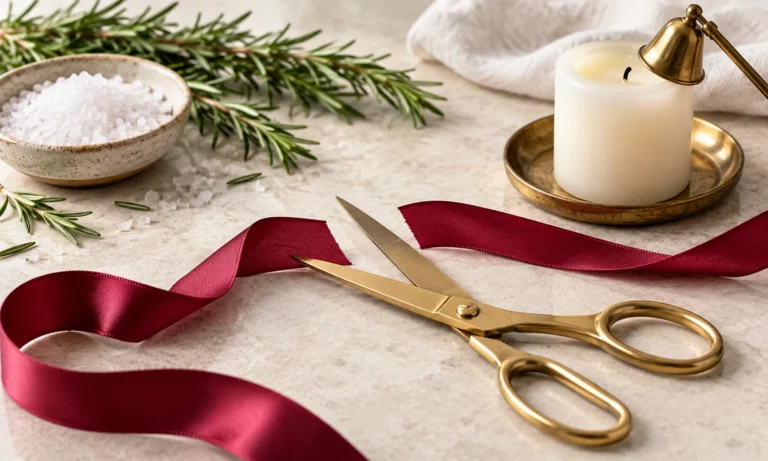
Use a natural fiber such as cotton, wool, linen, hemp or silk, around 9 to 18 inches long for a personal working or longer for a couple. Natural fibers can be buried or burned safely later; synthetic cord melts and gives off fumes.
Supplies for knot work
As an Amazon Associate we earn from qualifying purchases.
The table above lists traditional color and number meanings. Treat them as a vocabulary, not a rulebook. If a color reminds you of a person or a place you love, that personal meaning is just as valid.
The number of knots matters less than knowing what each knot stands for. Three is enough for a focused intention. Seven or nine give you room to name several qualities or promises, one per knot. Space the knots evenly and tie each one firmly but without straining the cord.
A Love Knot Spell for Two, With Consent
This version is for partners who both want to mark a commitment, an anniversary or a fresh start. Talk about it first, and agree on what you will do with the cord if either of you ever wants to release it. That conversation is part of the ritual.
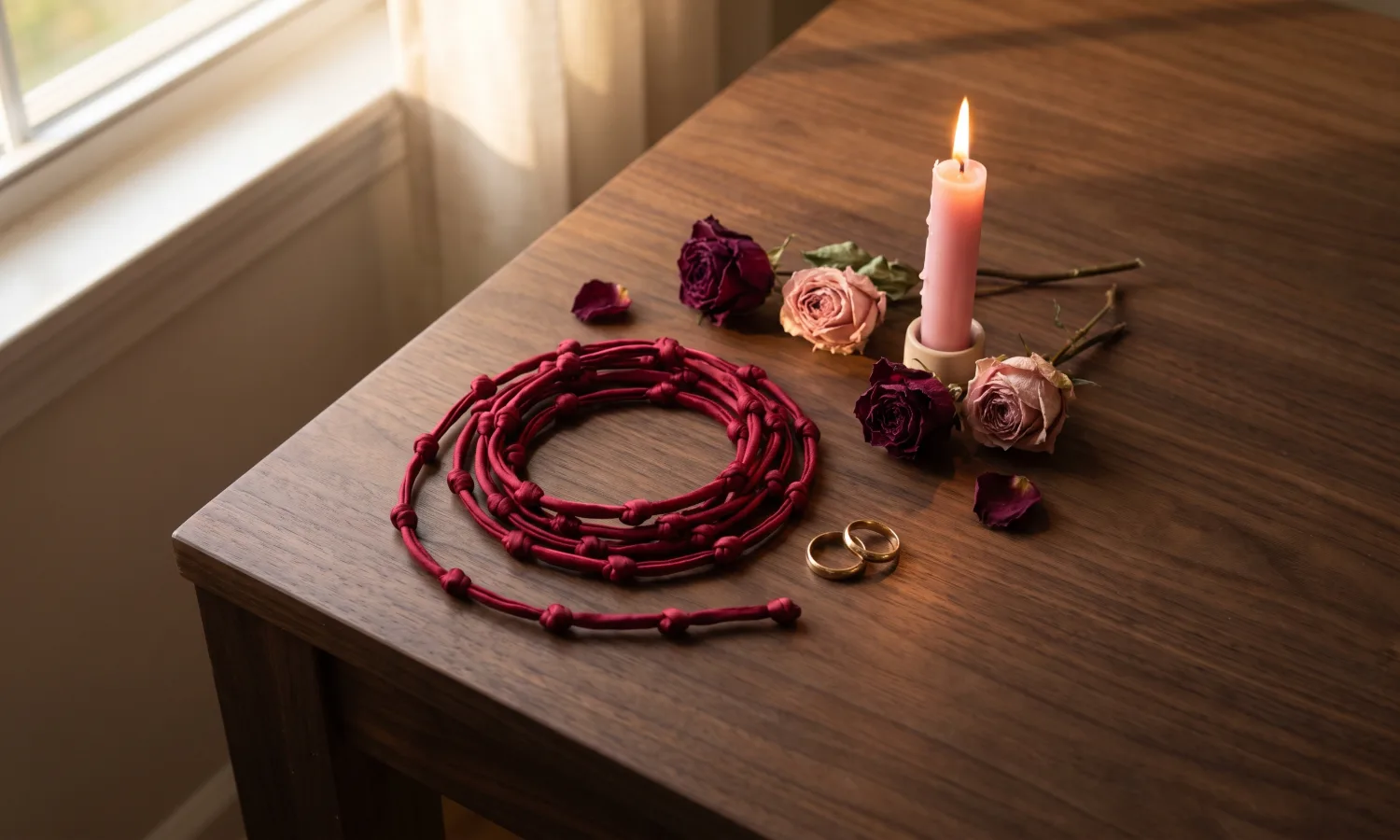
You need one cord about two to three feet long, or two cords of different colors held together, and a candle in a stable holder if you like.
- Sit facing each other with the cord between you, each holding one end.
- Take turns tying knots, working from the ends toward the middle. With each knot, say one promise out loud, such as “I will tell you the truth” or “I will make time for us.”
- Tie the final knot in the center together, both of you holding it, and say these words or your own: “Knot of thread and knot of heart, held by choice and free to part. What we tie, we tie in light, kept by care and not by might.”
- Sit quietly for a minute, then put out the candle.
- Keep the cord somewhere you both share, such as a box on a shelf in your bedroom.
On anniversaries, take it out together and reread the promises. This pairs well with our marriage spell guide if you are preparing for a wedding or a vow renewal.
A Self-Focused Knot Spell for Love
This version is for anyone, single or partnered, who wants to tie in the qualities they hope to bring to love. It takes about 15 minutes.
- Cut a pink, red or white cord about a foot long. Hold it and breathe slowly for a minute.
- Decide on seven qualities you want to embody or welcome, such as patience, honesty, playfulness, courage, warmth, steadiness and openness.
- Tie seven knots along the cord, naming one quality aloud with each: “With this knot, I tie in patience.”
- When the last knot is tied, hold the cord to your chest and say: “I carry these into every love I choose.”
- Keep the cord in a pouch, a drawer by your bed or your journal.
Each time you notice yourself living one of those qualities, touch its knot. The cord becomes a record of who you are becoming, not a leash on anyone else.
A witch’s ladder variation
To make a love-themed witch’s ladder, tie a small object into each knot as you go: a dried rosebud, a bead of rose quartz, a feather or a bay leaf. Hang the finished cord near your bed or in a window. Keep it out of reach of children and pets, since cats in particular can be harmed by swallowing string.
How to Keep, Untie or Release a Knot Spell
Knot workings have a built-in ending: untying. Decide which of these fits when the time comes.
- Keep it while the intention is alive. Store it somewhere dry and handle it now and then to renew it.
- Untie it to release the intention gently, working in reverse order from the last knot to the first. This suits an intention that has been fulfilled or one you have outgrown.
- Cut it when you need a decisive ending, such as after a breakup. Cutting is the heart of cord cutting, and it is a clean way to undo an old binding knot you regret.
- Burn it if it is natural fiber, in a fireproof bowl outdoors or by an open window, with water nearby.
- Bury it in soil if it is natural fiber with no beads or plastic.
For a couple’s cord, release it together if you can. If you part and cannot do it together, it is fair for either person to untie or cut it alone; that freedom was the point of making it with consent.
Want a personal perspective? If you and your partner are thinking about what you want to promise each other, a Commitment and Marriage Reflection offers a thoughtful look at your bond and the commitment you are both choosing freely. Join our free newsletter and your welcome email includes a 50% code for your first reading.
Frequently Asked Questions
What does a knot spell do?
In folk tradition, a knot spell holds an intention in a physical form until it is released. In practice, it gives you a tangible reminder of a promise or quality you have chosen. It cannot guarantee an outcome or change another person’s feelings.
How many knots should a love knot spell have?
Three, seven and nine are the most common numbers. Three suits a short, focused working; seven or nine leave room to name several qualities or promises. Choose the number that matches how many things you genuinely want to tie in.
What is a witch’s ladder?
A witch’s ladder is a knotted cord, often with feathers, beads or herbs tied in, that holds a series of intentions. The name comes from a feathered cord found in a Somerset house in the 1800s. Modern versions are used for everything from protection to self-love.
Is knot magic the same as a binding spell?
Every knot binds something, so the two overlap. A knot spell becomes a binding spell in the controversial sense when it is aimed at another person without their consent. Knots tied for yourself, or together with a willing partner, are a commitment rather than a capture.
What happens if the cord breaks?
Some practitioners read a broken cord as a sign that the working has run its course. Practically, cords wear out. Take a moment to ask whether the intention still fits, then either retie it on a new cord or let it go.
Disclaimer
Disclaimer: This article presents knot magic traditions for educational and spiritual purposes; no ritual guarantees an outcome, and none should be used to bind someone without consent. Never place cords around anyone’s neck, keep them away from children and pets, and seek qualified help if a relationship feels unsafe.