Weekly Love Guidance
Consent-first, practical guidance on love traditions, reconciliation, boundaries, and relationship clarity.

Love. Clarity. Choice.

A commitment spell is a symbolic ritual for clarity, not a way to control a partner. Learn its meaning, the ethics, and a shared ritual for couples who both choose it.
Quick answer: A commitment spell is a ritual people use to express a wish for a steady, loyal, long-term relationship. Ethical versions focus on your own clarity or on an intention that both partners choose together, never on forcing someone to stay. No ritual can make another adult commit, and none can promise an outcome. An honest conversation about what you each want is the most reliable step, with a shared candle ritual as an optional extra.
Related guidance: If you are new to this topic, start with our overview of love spells, their types, and their ethics, then read whether love spells really work, how love binding spells are described, and the gentler symbolism of a honey jar love spell.
| Approach | What it involves | Ethical standing |
|---|---|---|
| Self-focused clarity ritual | You write what you want from a relationship and what you can offer | Ethical; it involves only you |
| Shared couple’s ritual | Both partners choose a written intention, with an optional candle | Ethical when both agree freely |
| Honest commitment conversation | Each person states needs, hopes, and limits | Ethical, and often the most effective step |
| “Make him commit” spell | Aimed at one person’s choices, often without their knowledge | Crosses a line; it overrides free choice |
| Spell using a partner’s belongings | Hair, photos, or items taken without permission | A consent problem; avoid it |
Key Takeaways
A commitment spell is a ritual built around the wish for a relationship that feels steady, loyal, and headed somewhere. Practitioners describe it as a way to state an intention, focus your attention, and mark a moment of decision. It is usually grouped with love, binding, and marriage magic rather than treated as a category of its own.
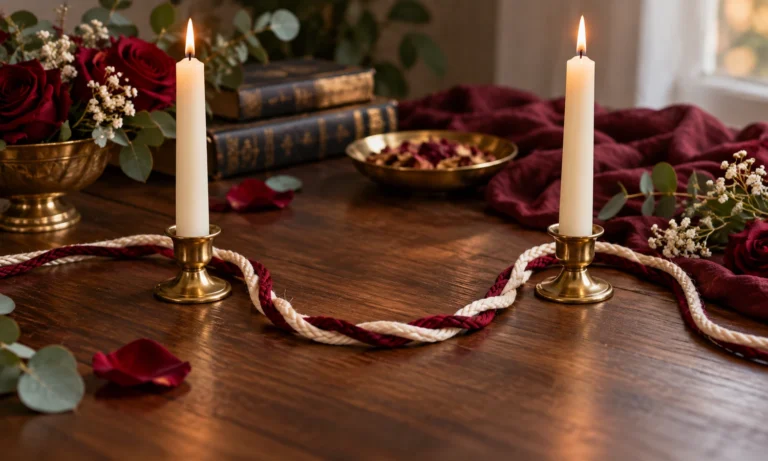
In folk tradition, commitment is often symbolized with knots, rings, braided cords, and paired candles. Each image points to the same idea: two separate strands becoming one. Some people also use honey or sugar to represent a relationship that feels sweet and secure.
These symbols are best read as a language for your own hopes. They are said to help you slow down and name what you want, which is often the hardest part. They do not reach into another person’s mind, and careful practitioners do not claim that they do. For a custom centered on weddings, see our guide to a marriage spell.
Many people search for a spell to make him commit (or her, or them) because they feel stuck. The relationship may be warm, yet months or years pass without a clear answer about the future. Wanting that answer is completely reasonable.
The trouble begins when the wish turns into a plan to override another person’s choice. A spell aimed at one specific person, especially without their knowledge, treats them as someone to steer rather than someone to talk to. Commitment produced by pressure is also fragile, because it does not rest on what the person actually wants.
Common ethical objections include the following:
For the same reasons, never use a partner’s hair, photos, or belongings in a ritual without their knowledge and agreement.
A healthier alternative is to point the ritual at yourself. Ask what you need from a relationship and what you will do if the answer is not what you hoped. That question turns a wish for control into a ritual for clarity, and it keeps the next step in your own hands.
Most stalled relationships are waiting on a conversation, not a ritual. Pick a calm moment rather than the middle of an argument or a late-night text exchange. Tell your partner you would like to talk about where the relationship is heading, and give them time to prepare.
It helps to speak from your own needs instead of demanding a verdict. Write down your own answers beforehand, too, so you know what you want, what you can be flexible about, and what you cannot compromise on. A few openers you might adapt:
Then listen to the answer, including the parts you may not want to hear. A clear “not yet” or “no” is painful, but it is information you can act on. You also get to set your own timeline and decide how long you are willing to wait. If these conversations keep stalling, couples counseling can give you both a structured space to talk.
If you both like the idea of a symbolic moment, a simple ritual can give the conversation a calm setting. It should feel like a shared pause, not a spell cast on someone. Either of you can say no or stop at any point, and it works just as well without a candle.
You will need two sheets of paper, two pens, and a candle in a stable holder on a heatproof dish. An LED candle works equally well and removes the fire risk.
If your partner does not want to take part, try a solo version. Write the same three sentences just for yourself, and focus on how you will care for yourself whatever the answer turns out to be.
A ritual like this may leave you feeling calmer and clearer, and it may make a hard conversation easier to begin. It cannot decide what your partner feels, and it comes with no timeline. Real commitment shows up in steady actions, such as making plans, being consistent, and including you in the future.
Commitment can also look different from one couple to another. Some people want marriage, some want a shared home, and some want a steady partnership without either. The goal is for both people to name their own version and see whether those versions fit.
Watch for these red flags:
If you ever feel controlled, frightened, or threatened in a relationship, or if someone has asked for no contact, respect that boundary and reach out to local support services or emergency services. A therapist or couples counselor can also help you sort out what you want and what is realistic.
A commitment spell is a ritual that expresses a wish for a steady, loyal, long-term relationship. Practitioners often use candles, knots, or written intentions to focus on what they want. Ethical versions are self-focused or shared by two willing partners. They are symbolic, cannot control another person, and come with no promised result.
No ritual can reliably make another adult commit, and trying to override someone’s free choice raises serious ethical concerns. Commitment that comes from pressure tends to be fragile. A more realistic approach is to state what you want, listen to your partner’s answer, and decide what to do based on what they actually say and do.
Choose a calm moment and speak about your own needs, such as wanting a relationship that is heading toward a shared future. Ask what commitment means to them and listen without interrupting. Avoid ultimatums and threats. If the conversation keeps stalling, couples counseling can give you both a structured space to talk.
A shared ritual can be a safe, meaningful pause when both partners freely agree and either can stop at any time. Keep it symbolic, such as writing intentions together. Use an LED candle, or a stable holder on a heatproof dish, and never leave a real flame unattended. Never involve a partner’s belongings without their permission.
Disclaimer
Disclaimer: This article is for education and cultural interest only, and it does not promise any outcome from a ritual. Commitment is a free choice for both people, so always respect your partner’s consent and boundaries. For relationship difficulties, consider a licensed counselor, and contact local emergency services if you feel unsafe.