Weekly Love Guidance
Consent-first, practical guidance on love traditions, reconciliation, boundaries, and relationship clarity.

Love. Clarity. Choice.
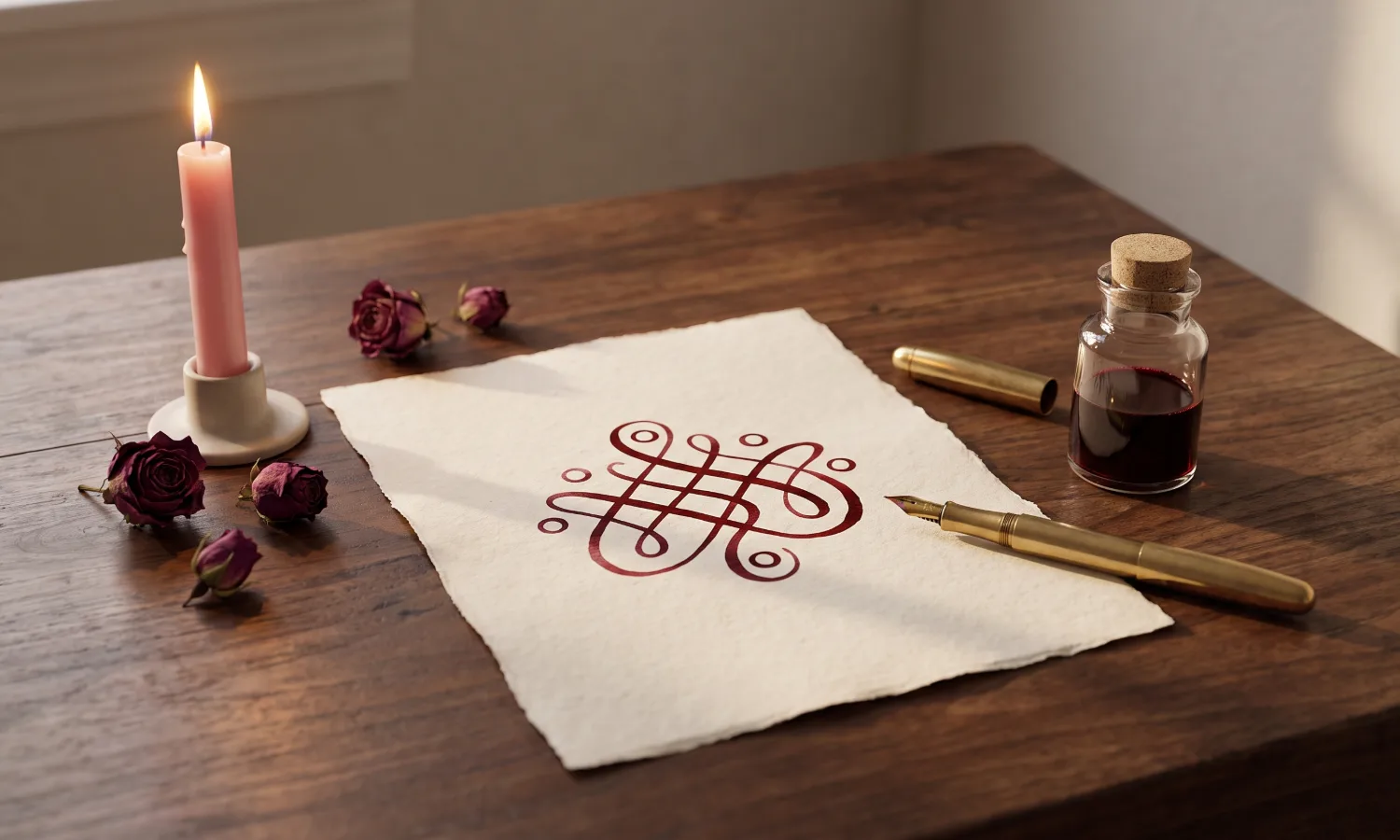
A love sigil turns a love intention into a private symbol. Learn the letter method step by step, how to charge and place your sigil, and which traditional love symbols to add.
Quick answer: A love sigil is a symbol you design from a written love intention, then charge and set aside so the intention can sit quietly in the back of your mind. The modern method: write a present-tense, self-focused statement, cross out repeated letters, merge the rest into one glyph, charge it with breath or candlelight, and let it go.
Related guidance: Pair your sigil with a gentle self-love spell, read how an attraction spell focuses on drawing the right partner, and learn how to word a love intention before you start drawing.
| Symbol | Traditional meaning | How to work it into a love sigil |
|---|---|---|
| Heart | Affection and emotional love; a romantic emblem in European art since the late Middle Ages | Enclose your glyph in a heart outline, or use one of its curves as a connecting line |
| Venus symbol (♀) | The planet Venus and the Roman goddess of love; also the alchemical sign for copper | Use the circle-and-cross as a base the other letters grow from |
| Rose | Love and beauty, long linked with Aphrodite and Venus; red for passion, pink for tenderness | Draw a simple five-petal rose at the center, or lay a real petal on the paper while charging |
| Love knot | Two interlaced loops with no beginning or end; a folk token of lasting affection | Frame a sigil about commitment or renewing a relationship |
| Two linked rings | Union, partnership and marriage | Add to a sigil that you and a partner design together |
| Dove | Gentleness and devotion; sacred to Aphrodite in Greek myth and a Christian sign of peace | Add a small wing shape to a sigil about peace in a relationship |
Key Takeaways
A sigil is a symbol created to hold a specific intention. The word comes from the Latin sigillum, meaning “seal,” and that is a useful way to picture it: a mark that seals a wish into a shape. A love sigil is a sigil whose intention concerns love, whether that means self-worth, meeting a partner, or deepening a relationship you already have.
Sigils have a long history in Western magic. Medieval and Renaissance grimoires drew seals for angels and planets, and Heinrich Cornelius Agrippa’s Three Books of Occult Philosophy (1533) included planetary seals traced from number squares, among them one for Venus.
The method most people use today comes from Austin Osman Spare (1886–1956), who described turning a written desire into a glyph in The Book of Pleasure (1913). Chaos magicians revived his technique from the late 1970s, and it spread from there into modern witchcraft.
In sigil witchcraft today, people draw sigils on paper, carve them into candles, trace them in oil, stitch them into fabric or hide them inside jars. A love spell sigil, for example, might be carved into a pink candle or placed under a honey jar. Many like sigils because they are private: no one else can read the intention. Whatever you believe about how they work, a well-made sigil is a compact reminder of what you are choosing to welcome.
You need scrap paper, a pencil, a good pen and about 20 minutes. Here is the full method, with a worked example.
A sigil does not need to be beautiful. It needs to be yours, simple enough to redraw from memory, and free of any readable words.
Charging means giving the sigil a moment of full, focused attention so it feels active rather than just drawn. Choose one method:
Then forget it. Put it away and resist checking on it. In Spare’s approach, forgetting is part of the method: the intention is meant to sink below conscious worry. It is also the healthiest step for an anxious heart, because it moves you from watching for signs back to living your life.
Candle safety: use a stable, heat-safe holder, keep paper away from the flame, never leave it burning unattended, and keep pets and children clear.
Choose a spot where the sigil can stay near you without becoming something you stare at all day:
When the sigil feels finished, or after one full moon cycle, retire it with thanks. Tear it up and recycle it, bury it, or burn it in a fireproof dish outdoors or near a sink, with water at hand.
Encoding someone’s name, initials or birth date into a sigil to make them love you is an attempt to bypass their choice. It also tends to keep your attention locked on one person, which feeds obsession rather than peace.
Build the sigil around qualities instead: “I welcome a partner who is kind and honest.” Or make it about your own readiness: “I am open to love that is freely given.” If you are in a relationship, design a sigil together, with both of you choosing the words. Two linked rings or a love knot make a good shared frame.
A love sigil condenses a love intention into a private symbol that you charge and then set aside. Practitioners see it as a way to plant an intention below everyday worry. At the least, it is a focused reminder of what you are choosing, which can shape how you act and whom you notice.
You can make a sigil about your relationship with someone, but not to override their will. Keep their name out unless they are creating it with you. A sigil for qualities, or for honest communication, respects both of you.
There is no fixed or guaranteed timeline. Many practitioners give a sigil one moon cycle before reviewing it. Judge results by changes in your own confidence and choices, and by real, mutual interest from others, not by signs or coincidences.
Yes, with care. Use a skin-safe pen or a diluted carrier oil, patch test first, and avoid broken or sensitive skin. Some people prefer a sigil traced invisibly with a fingertip, which carries the same intention with no risk.
No. Some practitioners burn a sigil right after charging to “release” it, while others keep it hidden until it feels complete. Both are traditional choices. If you burn it, use a fireproof dish, a safe space and water nearby.
Disclaimer
Disclaimer: This article is educational and spiritual content about sigil practice; no symbol or ritual guarantees a romantic outcome, and every person keeps the right to choose freely. For skin reactions, burns, or relationship safety concerns, seek help from a qualified professional or local emergency services.